/ RESEARCH NOTES
What the tokenizer hides.
A byte-level language model starts with the actual encoding of text. Byteification asks whether we can get there without throwing away a useful pretrained model.
Try the model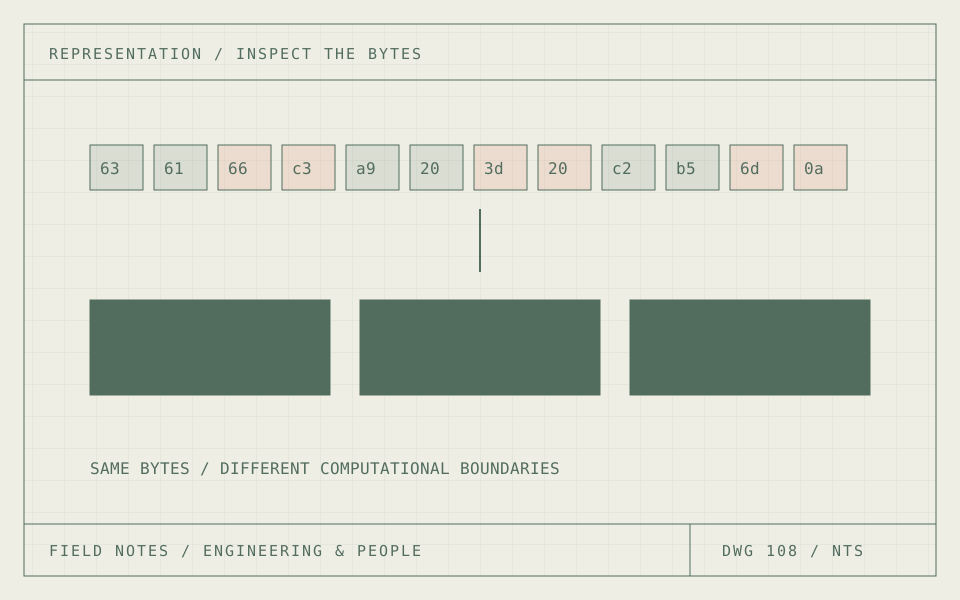
01 / READ THE METHOD
A small character can carry the whole requirement.
In an engineering drawing, a decimal point can change the tolerance. In code, a space or bracket can change behavior. A model that reads text through larger units still has to recover the fine structure when the task depends on individual characters.
Try the difference between “12.50 µm” and “1250 µm.” A reader can notice the point and the unit immediately. Designing a representation that makes those details accessible is a different concern from teaching the model what a tolerance means.
This paper is interesting because it challenges a boundary many application developers inherit without examining: the conversion from text into the sequence the model processes. Changing that boundary can affect what information is easy to use and how much computation is needed.
02 / READ THE METHOD
Keep the useful core and change its interface.
The authors describe byteification, a two-stage conversion of pretrained subword models. Local components encode bytes into patches and decode the global model’s representations back toward byte predictions. Stage one trains the new components while freezing the global model; stage two trains the full system.
The paper reports stronger results than earlier byte-level approaches and advantages on character-level reasoning tasks. The accompanying Bolmo project provides training and model resources. These findings motivate investigating byte-level representations; they do not establish that every task or deployment becomes faster.
The useful engineering pattern is adaptation around an existing core. If a costly component already works, changing its input and output machinery may be more tractable than rebuilding the entire system. The conversion still requires substantial training and evaluation.
Teaching accounting: byte count = sum of the bytes in every displayed patch
03 / READ THE METHOD
Inspect the encoding yourself.
The experiment uses your browser’s UTF-8 encoder. Type a short string and inspect the hexadecimal bytes. An ASCII character occupies one byte; many other characters occupy more. The test-tube emoji, for example, takes four UTF-8 bytes even though it is one Unicode code point.
Change the patch width to group that same byte stream into fixed-size chunks. The underlying bytes stay identical. A larger group means fewer groups, but this arithmetic alone says nothing about speed, understanding or the right boundary for a model.
These fixed byte groups are an illustration, not the paper’s learned boundary mechanism or a real subword tokenizer. A group can end partway through a multibyte character. The full stream remains decodable; an individual group is not promised to be readable text. That distinction is why the display uses hex.
04 / READ THE METHOD
Measure the detail and the cost together.
For a practical evaluation, I would assemble cases where exact text matters: identifiers, units, Unicode, structured records and small code edits. Include normal language tasks too. A representation change should be judged on what it gains and what it may give up.
Measure throughput, latency and memory at comparable workloads rather than comparing raw byte counts with token counts as if they were interchangeable. Output quality should be assessed with task-appropriate checks. An executable test is often more useful than an impression that a code sample looks plausible.
Keep spelling-level and semantic questions separate. Reading a decimal accurately does not imply that the model selected the correct engineering formula. Fine-grained access to the input is one requirement; applying domain knowledge correctly is another.
05 / READ THE METHOD
The representation is part of the product decision.
Try a plain identifier, a string with an accented letter and a string with an emoji. Watch code-point count and byte count separate. Then change patch width and confirm that the total number of bytes does not change.
The stage toggle explains which components are trainable in the two-stage outline. It does not train anything. Use it to think about the budget and verification burden of introducing new components around a pretrained system.
The broader lesson is to inspect the assumptions hidden in preprocessing. When an application depends on exact symbols, representation choices deserve the same scrutiny as prompts and output checks. The paper offers a concrete research direction for doing that without abandoning pretraining.
THE EXPERIMENT / CHANGE ONE THING
Look at the bytes before the model sees them.
Type a short string, change the illustrative byte-group width and inspect the two-stage conversion outline.
SYNTHETIC EXAMPLE / LIVE RESULTS
Stage 1 outline: freeze the global model and train new local components. This toggle runs no training. Fixed groups can split a character’s bytes; the complete stream is preserved.
63 61 66 c3a9 20 3d 2031 32 2e 3530 20 c2 b56dWhat this model assumes
Actual UTF-8 encoding of at most 96 input characters. Fixed-width byte groups illustrate compression accounting only; they are not learned Bolmo patches or real subword tokens. The stage toggle is descriptive. No language model or training executes.
SOURCES & FURTHER READING
The references behind the ideas.
The numbers in the experiment are illustrative. These references support the methods and distinctions discussed in the article.
- Retrofitting language models to operate over bytes ↗
Journal publication 7 October 2026. Peer-reviewed / Nature. The primary source for the method and reported evidence.
- Authors’ implementation and supporting material ↗
Original project resources. The browser experiment is an independent teaching illustration, not this implementation.