/ SEMICONDUCTORS
Everyone wants a piece of NVIDIA.
I started looking through NVIDIA’s physics libraries and ended up reading about chips, customer funding and what it would take to switch platforms.
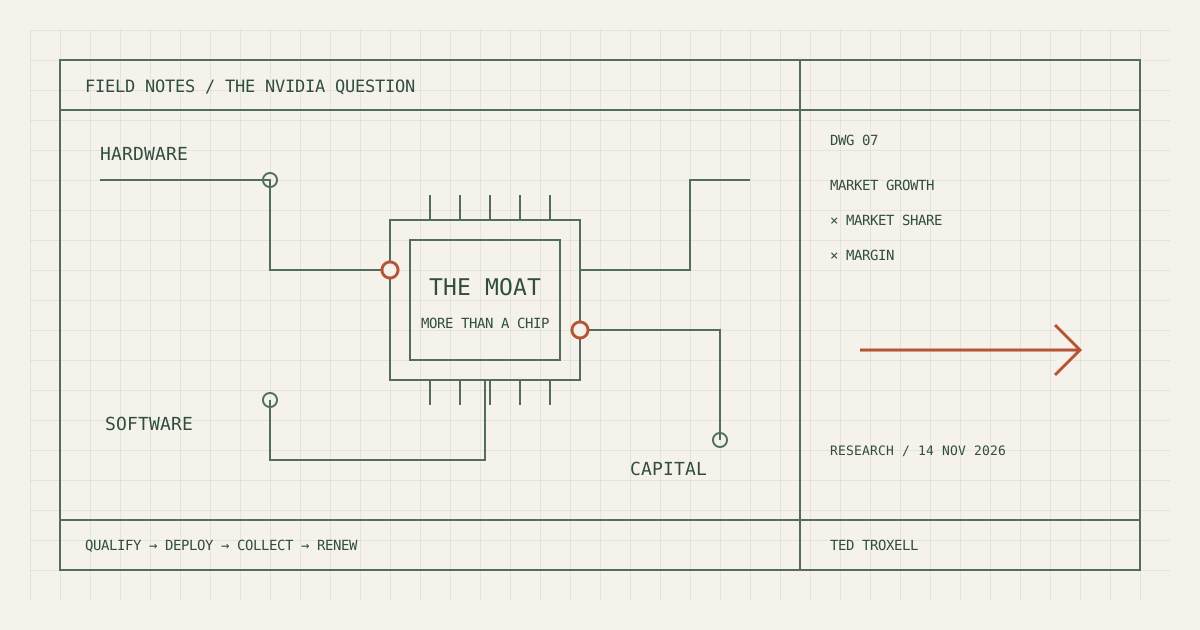
01 / THE NVIDIA QUESTION
What got me looking at the libraries
I got interested in this while looking through NVIDIA’s physics libraries: Modulus, now PhysicsNeMo, and Warp. A lot of the underlying methods were familiar from research papers. Seeing NVIDIA put them together into software made me wonder what it expected to get out of the effort. [S46][S48]
My first reaction was: do we really need another toolkit? A collection of papers wrapped in an API doesn’t automatically excite me. I’m more interested in whether it saves someone enough work that they actually keep using it. Warp was the part I wanted to dig into more, so I wondered why NVIDIA was also putting effort into the broader collection.
Looking at what the tools actually do helped. PhysicsNeMo includes neural operators, graph networks and physics-informed neural networks, along with data pipelines, training utilities and examples. Getting those pieces to work together is useful work in its own right. Warp sits lower down: it compiles Python functions into CPU or CUDA kernels for things like simulation, and supports differentiation and connections to ML frameworks. They give a developer different starting points. [S46][S47]
That gave me a possible business explanation too. If the software makes a project easier to get running, more teams may try it. Some of those projects could grow into workloads that need more NVIDIA hardware. The library could be worth maintaining even if nobody pays for it directly. That’s the connection I wanted to investigate; the filings can help test it, but they can’t tell me every reason NVIDIA made the decision. [S01]
I’m still more drawn to something like Warp, where a developer gets building blocks and can decide what to do with them. But I can see the appeal of a more complete example if it gets a team past the setup work. My test for either would be pretty practical: does anyone keep using it once the demo is over, and does that turn into more hardware spending?
The documentation includes applications and contributors, so there are people finding uses for the tools. What I wanted to understand was how much of that usefulness comes back to NVIDIA when a customer has more hardware options. I started putting the company results alongside each other to get some context.
+106% year over year
Prior year: 100 · Current: 206
Q2 FY2027 ended July 26 2026. GAAP revenue, USD billion. [S03]
+45% year over year
Prior year: 100 · Current: 145
Q3 2026 ended September 26 2026. GAAP revenue, USD billion. [S04]
+221% year over year
Prior year: 100 · Current: 321
Q3 FY2026 ended August 2 2026. Issuer-defined AI semiconductor revenue, USD billion. [S06]
+70% year over year
Prior year: 100 · Current: 170
Q3 2026 ended September 30 2026. Non-GAAP core revenue, USD billion. [S18]
Each prior-year quarter is indexed to 100. Different periods and revenue definitions: NVIDIA and AMD total revenue, Broadcom AI semiconductor revenue, Cerebras non-GAAP core revenue. These bars cannot be added together or used to calculate accelerator market share.
The growth figures made the question more interesting. A competitor can grow quickly while NVIDIA keeps growing too, particularly when the overall market is expanding. That means I need to look at pricing, margins and where new spending goes, rather than treat a competitor’s growth as an equal loss for NVIDIA.
02 / THE NVIDIA QUESTION
What a competing chip has to get right
I get skeptical when a “NVIDIA killer” pitch stops at the chip specs. I want to know how the thing gets manufactured, packaged, delivered and put to work. A strong chip result is worth paying attention to, but the customer still has a whole system to run.
The engineering choices also affect each other. Adding compute can add heat and power demand. More memory bandwidth changes the package and its cost. A larger design can make manufacturing losses more expensive. Then there’s verification before fabrication, and software that has to make good use of the finished hardware. [S01][S44]
01 / DEFENSIBILITY / INTERACTIVE WORKSHEET
INPUTS → CALCULATION → OUTPUTSA moat with several layers
WHAT A CHALLENGER HAS TO REPLICATE
Architecture + verification
The accelerator has to compute correctly, move data efficiently and meet timing, power and thermal limits. A fast design that fails validation is not a product.
- NVIDIA’s position
- NVIDIA combines architecture, compilers and repeated product cycles. That accumulated feedback helps it choose and validate tradeoffs.
- What to measure
- R&D intensity, design-cycle execution and performance at a fixed workload.
- Where AI could help
- AI can help generate scripts, analyze bugs and explore designs. The generated design still needs verification.
These are mechanisms to investigate, not numerical moat scores. Supplier capabilities are distinguished from capabilities NVIDIA owns.
One thing I had to separate was the difficulty of making chips from the advantages NVIDIA itself owns. NVIDIA is fabless. TSMC runs the manufacturing process and fabs, while memory and packaging suppliers bring their own expertise. NVIDIA benefits from its planning, scale and work with those partners, but competitors can use some of the same suppliers. A manufacturing bottleneck can make entry difficult without belonging exclusively to NVIDIA. [S01][S44]
02 / UNIT ECONOMICS / INTERACTIVE WORKSHEET
INPUTS → CALCULATION → OUTPUTSDesigning the chip is only part of the bill
HYPOTHETICAL PROGRAM / USD / NOT NVIDIA COST DATA
Editable assumptions
Held constant: a $20,000 wafer and 80 gross candidate dies per wafer. All defaults are invented teaching inputs. Effective yield is one simplified loss factor.
Cost per shippable unit
Green: wafer. Sage: packaging + memory. Coral: fixed design amortization. Values above supply the exact amounts.
Formula, exclusions and what this tells us
Good dies = gross candidate dies × effective yield. Unit cost = wafer cost ÷ good dies + packaging/memory + fixed design program ÷ lifetime shipped units.
Higher yield lowers wafer cost per good part. More sales spread a fixed program across more units. This omits die-area changes, packaging losses, binning, royalties, support, financing, selling costs and profit. It is not a bill of materials, selling-price estimate or complete fab model.
Try moving yield and volume separately in the worksheet. Lower yield makes each usable part more expensive; lower volume spreads the design bill across fewer sales. That helped me see why cheaper engineering alone might not be enough. It also leaves room for a specialist that can make the numbers work for a narrower set of customers.
For me, the comparison gets interesting when someone can show the cost of running the customer’s actual workload at the required performance and reliability. I’d include power, utilization and the engineers needed to keep it working. If a supposedly cheaper chip leaves a team doing months of extra software work, I want that in the comparison too.
03 / THE NVIDIA QUESTION
How much of this can AI make easier?
This was the next thing I wanted to check. If AI is getting better at coding and engineering work, does a smaller chip team have a much better shot now? There are useful examples: Google’s AlphaChip works on floorplanning and has been used in TPU designs. NVIDIA’s ChipNeMo looks at engineering assistance, EDA scripts and bug analysis. Those cover particular tasks, so I’d be careful about extending the results to a whole chip program. [S42][S43]
I’m excited about AI taking some of the tedious engineering work out of this. I just want to be honest about which work it removes. In the example below, speeding up 12 months of work by 2× while leaving eight months unchanged takes the total from 20 months to 14. I’d happily take those six months back. I wouldn’t describe the whole program as twice as fast.
03 / DEVELOPMENT PRODUCTIVITY / INTERACTIVE WORKSHEET
INPUTS → CALCULATION → OUTPUTSFaster tasks do not mean an equally faster chip
HYPOTHETICAL SERIAL SCHEDULE / MONTHS / NOT A FORECAST
Task assumptions
Schedule comparison
Green: accelerated work. Sage: unchanged work. Negative difference means the entrant finishes sooner under your assumptions.
Program time = eligible time ÷ task speedup + unchanged time
Why these are assumptions, not research results
AlphaChip addresses floorplanning. ChipNeMo evaluates engineering assistance, EDA scripts and bug analysis. Neither supplies a universal whole-chip development speedup. The sliders are deliberately independent: better AI may help entrants, incumbents or both. [S42][S43]
The model assumes sequential stages and no rework. Actual programs have parallel dependencies, fabrication queues and validation loops. “Unchanged” means unchanged in this scenario, not that AI can never improve manufacturing.
Fabrication, packaging and validation can still take time after the design work speeds up. AI may help with those stages too; TSMC and NVIDIA describe applications in manufacturing, simulation and inspection. I just wouldn’t use a simulation speedup as a stand-in for how quickly a supplier can deliver qualified hardware. [S44][S45]
The part I’m wary of is assuming better AI mainly helps the challenger. NVIDIA gets to use it too, and ChipNeMo shows it adapting models to chip-design work. I’d expect a pile of design history and engineers who know what went wrong last time to be useful here. I don’t have a number for that advantage, which is why the two speedups stay separate in the worksheet. [S43]
04 / THE NVIDIA QUESTION
Who is trying to build an alternative?
The companies in this group aren’t all trying to do the same thing. AMD offers a GPU alternative. A cloud provider can build a chip mainly to replace some of its own spending. A specialist might only need to be good at one workload to find a business.
I’m interested in who gets funded, but I get a lot more interested when someone pays to run production work and then comes back for more. A funding round buys a team the chance to prove something. I don’t want to give it credit for already having proved it. The explorer keeps those stages separate.
EXPLORE THE ALTERNATIVES / SELECT A COMPANY
I’d use Crunchbase, PitchBook or Dealroom to find companies worth following, then look for filings and evidence of deployments, utilization and repeat business. Funding alone doesn’t tell me which chip is taking work from NVIDIA. I’d also check whether a reported deal is a new round, a revision to an earlier announcement or debt, so the same money doesn’t get counted twice.
05 / THE NVIDIA QUESTION
What would it take to switch?
This brought me back to the software question. If a team already has a working system, what would make it worth moving? The comparison includes its code, debugging tools and all the things the operations team has learned about keeping it running.
This is where I think NVIDIA’s software spending starts to look pretty sensible. A team picks up a useful library, adds its own optimizations and builds more work around it. Eventually, changing the chip means touching a bunch of things that already work. I can see why a team would need a fairly good reason to volunteer for that.
MOVE A WORKLOAD / A QUALIFICATION CHECKLIST
Choose a workload, then mark the questions you have checked. These are practical dependencies, not a migration-cost estimate.
Framework-level portability is a starting point. Custom CUDA extensions, numerical behavior and distributed training still need testing.
Check operator coverage, precision support and performance on the actual model. A successful import is not performance parity.
Collectives, networking, checkpoint recovery and utilization can decide the economics.
0 of 3 areas marked reviewed. A checked box records your exploration; it does not certify portability.
[S01][S28][S34][S35]Reading the physics software also made me pay closer attention to backends. The license tells me what I’m allowed to do with the code; the supported backends tell me where I can run it. NVIDIA has open projects and products with specific GPU requirements, so I need to check the particular tool rather than infer portability from its license. [S28][S30][S34][S35]
That’s the part of the moat I find most convincing so far. It doesn’t require an elaborate plan to close the code later. Being the system people already know how to build and operate can be a pretty good position. Whether it holds up depends on how much better or cheaper the alternative really is.
06 / THE NVIDIA QUESTION
The funding relationships were interesting too
The financing is where I started opening more tabs. Suppliers investing in customers, capacity agreements helping fund data centers, warrants encouraging a buyer to commit: there’s a lot going on around the hardware order. I put a few of the documented relationships into the map because I wanted to keep track of who was funding whom.
There are sensible reasons for those arrangements. They can help get infrastructure built and give customers access to compute. What interests me financially is how much expansion depends on continued financing, and whether several companies end up exposed to the same slowdown.
CAPITAL / CONTRACTS / INCENTIVES
Equal-width arrows show direction of the labeled relationship, not cash volume. Solid green: equity. Dashed green: capacity programs. Coral: loans or warrants. Numbers match the cards.
NVIDIA → OpenAI
$30B announced investment
February 2026 financing announcement. Not a claim that all cash was disbursed. OpenAI also announced 3 GW inference and 2 GW training capacity on Vera Rubin.
[S13]I haven’t added the relationships into one dollar total. Buying equity, lending to a customer, issuing warrants and committing to capacity create different obligations. I’d rather keep the terms visible than put unlike figures into a single headline number.
I’m not going to call a customer investment fake demand just because the diagram loops back on itself. I do want to know whether the customer can pay without another financing round. That sends me back to cash collection, receivables, payment terms and customer concentration, along with evidence that the compute is actually being used. [S01][S02]
07 / THE NVIDIA QUESTION
Working through the numbers
By this point I wanted to put some numbers around the argument. The worksheet separates market growth, NVIDIA’s share and the margins on that revenue. They can move in different directions, which is easy to lose sight of when reading competition headlines.
04 / INVESTMENT SENSITIVITY / INTERACTIVE WORKSHEET
INPUTS → CALCULATION → OUTPUTSA financial model, with the assumptions in view
ILLUSTRATIVE EXPOSURE MODEL / INDEXED / NOT A STOCK VALUATION
Case: Diversification. Presets are illustrative cases with no assigned probabilities.
Model inputs
Year-four profit bridge
Initial revenue 100, assumed share 85%, initial gross margin 75%, operating costs 15%: initial profit 60.
Two-variable profit sensitivity
Cells show operating-profit multiple versus initial profit 60. Market growth (35%) and operating costs (18%) stay at your settings. Terminal share and gross margin vary. Green is at least 1× initial profit; coral is below it.
| Share / margin | 60% | 65% | 70% | 75% | 80% |
|---|---|---|---|---|---|
| 50% | |||||
| 60% | |||||
| 70% | |||||
| 80% | |||||
| 90% |
Model formulas and limitations
Revenue₄ = 100 × (1 + growth)⁴ × (share₄ ÷ 85%)
Operating profit₄ = revenue₄ × (gross margin₄ − operating costs₄)
Intermediate share changes linearly. Terminal margins determine year-four profit only. Initial share is a teaching assumption, not measured NVIDIA market share. This is not a model of every NVIDIA business. It excludes taxes, stock compensation adjustments, capital expenditure, working capital, investment returns and valuation multiples. An operating-profit increase is not a stock-price forecast.
Try taking share away from NVIDIA while leaving margins alone, then start moving the margin and cost inputs. This is why I’m reluctant to turn “more competitors” straight into “bad investment.” The revenue can keep growing. The part I’m less willing to take for granted is how much profit NVIDIA keeps. These presets are examples, not cases I’ve assigned odds to.
It also makes me cautious about treating the semiconductor industry as one investment. Chip designers, foundries, memory suppliers and cloud operators can all benefit from more spending, but they have different costs and bargaining positions. I’d want to work through those separately before deciding who keeps the return.
08 / THE NVIDIA QUESTION
Where I’ve landed so far
I think the software effort makes a lot of commercial sense. If the tools help people get useful work running, NVIDIA can benefit well before it ever charges for the software. And once a team has built around that stack, a competing chip has more work to do than win a benchmark. That’s where I’ve landed on the moat argument. The stronger claim that NVIDIA plans to make all physical AI software NVIDIA-only still needs evidence I haven’t found.
What fits the hunch
The clearest examples for me are the tools that make a system easier to build and the specific places where NVIDIA hardware is required. The strategic relationships add another reason to look at how adoption develops.
[S01][S28][S29]What complicates it
There are CPU backends, open licenses and customers planning to use several hardware suppliers. I need to account for those too. The dependencies vary enough that I would check each tool rather than call the whole ecosystem locked in.
[S10][S11][S34][S35]What I’d watch for
I’d take the dependence argument more seriously if important backends became more restrictive, migrations got more expensive, or buyers kept choosing NVIDIA after qualifying alternatives. I’m listing those as things to watch, not things this research has established.
What would make me reconsider
I’d want to see customers move production workloads repeatedly, keep comparable service quality and spend less overall. If the software work also gets easier with each move, that would weaken the switching-cost argument. I’d need more than an announcement to judge it.
I’m going to pay more attention to production migrations, repeat purchases and cash collection than to the next claim that someone has killed the GPU. I think the alternatives are worth taking seriously. I also think making NVIDIA easier to leave is a much bigger job than designing another chip. Whether that keeps its current economics intact is the part I still want to watch.
RESEARCH METHOD / TAKE IT WITH YOU
Try this with your own question.
I’ve packaged the research approach into a skill you can give to an AI assistant. It works outside chips and AI: pick a company, industry, technology or market you’re curious about.
It starts by asking what you want to find out, what prompted your hunch and what decision the answer should inform. Then it works through sources, alternative explanations and the numbers, keeping the gaps visible.
Download SKILL.md ↓ Download the ZIP ↓
One Markdown file. No scripts, credentials or datasets. The ZIP contains only evidence-led-research/SKILL.md, with the folder ready to install.
Install it or use it in another assistant
For Codex, unzip the folder into ~/.codex/skills/, or save the Markdown file as ~/.codex/skills/evidence-led-research/SKILL.md. Start a new session so the skill is discovered.
Then ask: Use $evidence-led-research to investigate whether grocery delivery can be a sustainable business. Ask me the scoping questions first.
For another assistant, attach the Markdown file or paste its contents into a new chat, then describe your question. The assistant needs browsing access for current research. Installation support varies by product.
The download gives you the method, not this article’s conclusions. It asks what would change your mind, tracks sources and distinguishes reported facts from assumptions and interpretation.
RESEARCH NOTES / FOLLOW THE EVIDENCE
Sources and limits
I used company filings, technical documentation and partnership announcements for this piece, with a research cut-off of 14 November 2026. Announced targets stay labeled as targets. The companies report different periods and revenue categories, so I haven’t used their results to calculate market share. I also haven’t worked from a complete paid funding database.
- S46 / Accessed 2026-11-14NVIDIA documentation: PhysicsNeMo framework overview ↗
Research model families, data pipelines, distributed training, example applications and community contributions
- S47 / Accessed 2026-11-14NVIDIA Warp documentation: Warp stable documentation overview ↗
Python-to-CPU/GPU kernel compilation, differentiability, simulation primitives and ML interoperability
- S48 / Accessed 2026-11-14NVIDIA documentation: PhysicsNeMo module compatibility implementation ↗
Compatibility remapping of historical modulus imports to physicsnemo; deprecation warning
- S42 / 2024-09-26Google DeepMind: How AlphaChip transformed computer chip design ↗
Floorplanning scope; TPU deployments; vendor-reported results, not end-to-end development speedup
- S43 / 2023-10-30NVIDIA Research: ChipNeMo: Domain-Adapted LLMs for Chip Design ↗
Engineering assistant, EDA scripting and bug analysis; domain adaptation; no autonomous complete chip claim
- S44 / FY2025TSMC: 2025 Annual Report ↗
Technology development, yield, capacity, advanced packaging and customer process ecosystem
- S45 / 2026-10-14NVIDIA: NVIDIA and Semiconductor Leaders Advance AI Across Chip Design and Manufacturing for AI-Defined Fabs ↗
Issuer claims about simulation, inspection and design tools; selected task results not whole-program outcomes
- S01 / Year ended 2026-01-25NVIDIA / SEC: Fiscal 2026 Form 10-K ↗
Business strategies; Competition; MD&A; investments and guarantees
- S02 / Quarter ended 2026-07-26NVIDIA / SEC: Fiscal 2027 second quarter Form 10-Q ↗
Balance sheet; Notes 6, 10 and 14; MD&A liquidity and export controls
- S03 / 2026-08-26NVIDIA: Second quarter fiscal 2027 earnings release ↗
Financial results; Data Center; Q3 outlook
- S04 / 2026-11-03AMD: Third quarter 2026 earnings release ↗
GAAP results; Segment summary and disaggregated revenue
- S06 / Quarter ended 2026-08-02Broadcom: Third quarter fiscal 2026 earnings release ↗
CEO commentary on AI semiconductor revenue and Q4 outlook
- S10 / 2025-10-13OpenAI and Broadcom: Collaboration for 10 GW of custom accelerators ↗
Deployment target and schedule
- S11 / 2025-10-06OpenAI and AMD: Partnership for 6 GW of AMD GPUs ↗
Initial deployment; milestone-linked warrant
- S12 / 2026-02-27OpenAI and Amazon: Strategic partnership ↗
Trainium capacity; financing and AWS infrastructure
- S13 / 2026-02-27OpenAI: Scaling AI for everyone ↗
NVIDIA and Amazon investment announcements; compute capacity
- S15 / 2026-04-20Anthropic: Amazon compute collaboration ↗
Trainium installed base; future capacity; investment
- S16 / 2026-04-22Google Cloud: Eighth generation TPU architecture ↗
Training and inference specialization
- S17 / 2026-10-12Microsoft: Azure Maia multi-gigawatt deployment plans ↗
Maia 200 production; Maia 300 2027 plan
- S18 / 2026-11-12Cerebras: Third quarter 2026 earnings release ↗
GAAP versus core results; RPO; FY outlook
- S19 / Quarter ended 2026-09-30Cerebras / SEC: Third quarter 2026 Form 10-Q ↗
OpenAI MRA; working capital loan; revenue accounting
- S20 / 2026-10-19Tenstorrent: Series E financing ↗
Funding amount and post-money valuation
- S28 / Living documentation accessed 2026-11-14NVIDIA: Isaac Lab 3.0 installation requirements ↗
GPU training and rendering requirements
- S29 / Living page accessed 2026-11-14NVIDIA: NVentures portfolio and investment approach ↗
Physical AI portfolio; technical integration support
- S30 / 2025-09-29Linux Foundation: Newton contribution announcement ↗
Open governance and collaborators
- S34 / Living page accessed 2026-11-14NVIDIA Warp: Source repository and supported backends ↗
Installing; CPU and CUDA support
- S35 / Living page accessed 2026-11-14Newton project: Physics engine repository ↗
License and requirements
- S40 / September 2025CoreWeave / SEC: NVIDIA residual capacity purchase order Form 8-K ↗
September 9 agreement; initial value and delivery conditions
- S41 / 2026-01-26CoreWeave and NVIDIA: AI factory collaboration and NVIDIA equity investment ↗
Equity purchase and planned infrastructure expansion